A chauffeur airport transfer in London is a pre-booked, fixed-price service in which a professionally presented, TfL-licensed driver meets you by name at arrivals, tracks your flight in real time, and manages your journey from door to door — with no surge pricing and no hidden fees. A standard minicab is also a pre-booked private hire vehicle, but typically offers fewer service guarantees: pricing may change at booking or at the point of travel, waiting time policies vary, and driver presentation standards are inconsistent. The key practical differences are price transparency (chauffeur services fix your fare at the time of booking), reliability (flight tracking means your driver adjusts to delays automatically), and service level (meet-and-greet, luggage assistance, and vehicle quality are standard with a chauffeur transfer, optional or absent with a minicab). For London airport journeys, the gap in actual cost between the two is often smaller than expected — particularly when compared against Uber’s surge pricing during peak travel hours.
For anyone booking a journey to or from London’s six major airports, understanding the distinction between a chauffeur transfer and a standard minicab isn’t about choosing luxury over economy. It’s about choosing certainty over uncertainty — and, paradoxically, often saving money in the process.
How TfL Licensing Works — and Why It Doesn’t Tell the Whole Story
The first point of confusion: there is no separate “chauffeur licence” under Transport for London’s regulatory framework. Both chauffeur services and standard minicabs operate under the same Private Hire Vehicle (PHV) licensing system. TfL licenses over 100,000 PHV drivers across London, and every legitimate operator — whether positioned as budget or premium — holds an operator’s licence separate from the individual driver’s PHV licence.
This is important because it means the regulatory bar is the same. All TfL-licensed drivers (sometimes referred to as PCO drivers, using the older name for the licensing body) must pass criminal background checks, hold a valid driving licence, and comply with vehicle standards — notably, vehicles must be under 15 years old. The law doesn’t create a tier called “chauffeur”; the label describes how an operator chooses to run their service, not what the government requires them to do.
Where the real difference emerges is in operational standard. A chauffeur service operator invests in enhanced DBS checks, driver training, vehicle quality control, and service protocols — meet-and-greet processes, real-time communication, and accountability measures — that TfL licensing doesn’t mandate but that separate a professional chauffeur operation from a budget minicab firm running the bare minimum.
It’s worth clarifying one more distinction: a black cab (Hackney Carriage) operates under a different licence altogether. Black cab drivers must pass The Knowledge — a rigorous exam of London’s streets — and can legally be hailed on the street or at a rank. They operate on a metered fare set by the local authority. For spontaneous journeys, black cabs are convenient; for pre-planned airport runs with a firm quote, they’re rarely the competitive choice, as meter-based pricing leaves you vulnerable to congestion and traffic delays.
The Real Cost of “Cheap” — Surge Pricing, Hidden Charges, and the Airport Problem
The most common reason travellers regret choosing a budget minicab or ride-hailing app for an airport transfer is the financial shock at the end of the journey.
Ride-hailing apps like Uber are famous — and documented — for surge pricing at airports. During peak travel times (bank holidays, early mornings, bad weather, major events), fares routinely multiply by 2x to 3.5x the base rate. The Guardian and Which? have both documented these spikes, particularly at Heathrow during school holidays and around Christmas. You book your ride home after a week away, exhausted, and discover you’re paying £120 for a journey that would normally cost £35.
Standard minicabs, meanwhile, often quote a price but bury the detail in the fine print. The base fare might be £40, but then the congestion charge (£15 in central London), ULEZ charge (£12.50 if your journey enters the Ultra-Low Emission Zone), tolls (Dartford Crossing adds up to £3 each way), and waiting-time fees (charged from your scheduled landing time, not your actual landing time) can add another £30 to your bill. If your flight arrives 45 minutes late and the minicab’s waiting-time policy charges per 15-minute increment, you’ve just paid extra for delays outside your control.
Here’s the counter-intuitive truth: a fixed-price chauffeur transfer is often 20–40% cheaper than Uber during peak hours. A fixed-price airport transfer from Heathrow to central London locks in your cost at booking — congestion charge, tolls, and waiting time all included. No surge multiplier. No hidden line items. When you compare that certainty against the lottery of surge pricing, the chauffeur option often costs less, not more.
The anxiety of not knowing what you’ll pay until you’re already committed to a journey is real. Airport transfers involve tight schedules; changing your booking last-minute because the fare has jumped 3x is impractical. Fixed pricing removes that risk entirely.
What Happens at the Airport — Practical Differences That Matter
The airport environment is where the difference between a chauffeur service and a standard minicab becomes visceral.
Flight tracking is a cornerstone of a professional chauffeur service. Your driver monitors your flight in real time using live airline data. If your flight is delayed by 90 minutes, your driver knows this automatically — and your pickup time adjusts accordingly. You don’t pay a penalty for a delay outside your control. A standard minicab typically charges from your scheduled arrival time; if your flight is late, you’re paying waiting-time fees from the moment you were supposed to land, even if your driver isn’t at the airport yet.
Meet and greet is more than a nice phrase. When a driver holds a name board at arrivals, you don’t need to phone around trying to find them or hunt through airport car parks. They’re waiting for you at baggage reclaim — they take your luggage, usher you to a vehicle of known quality, and you leave the airport within minutes. The meet and greet service at Heathrow is standard with Direct Airport’s executive bookings, which means you’re not negotiating over whether this extra is included or what it costs.
Communication under the two models is fundamentally different. With a chauffeur service, you get a named driver and a direct contact number. If plans change, you call your driver and speak to a real person. With ride-hailing apps, you’re matched with a driver algorithmically — and if that driver cancels (a documented problem on London airport runs at 4am and 5am — Reddit’s r/london is full of accounts of travellers matched with multiple drivers who cancel in succession) you’re re-matched with another. Airport runs at unsociable hours are when this model breaks down most spectacularly. A pre-booked chauffeur eliminates this entirely.
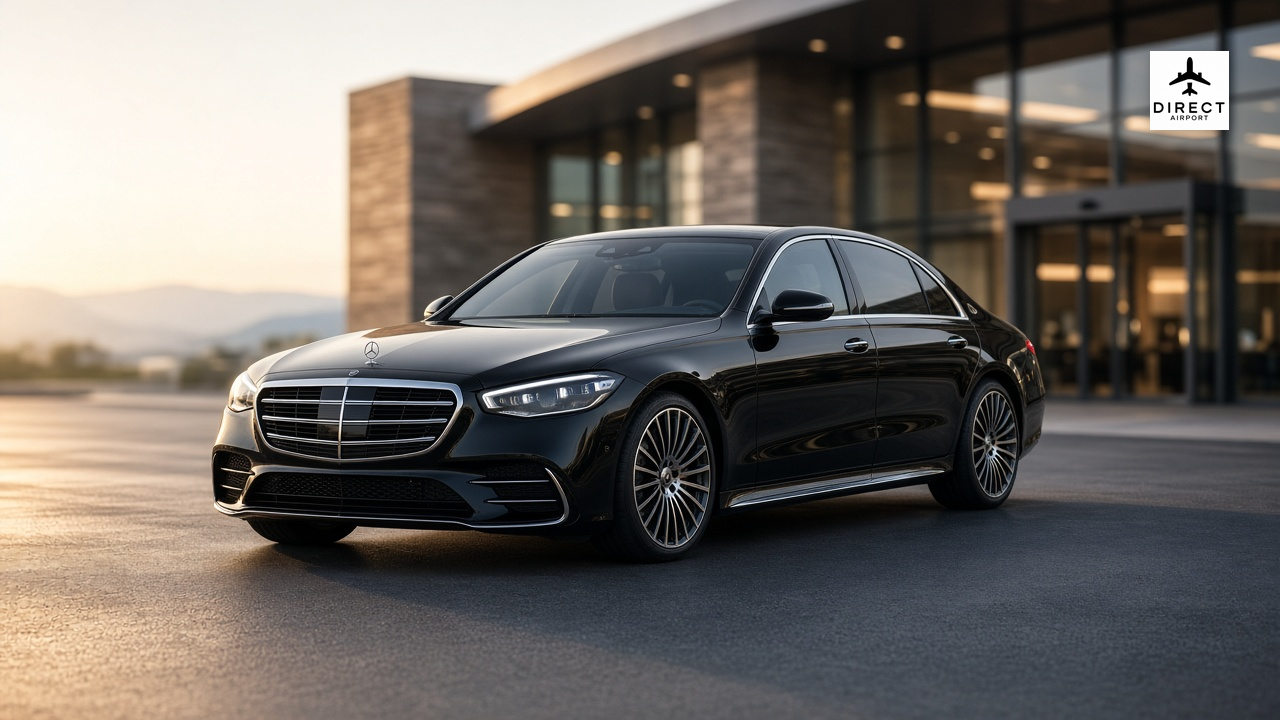
Vehicle quality matters too. A chauffeur service operates a fleet to a known standard: executive saloons, MPVs with guaranteed luggage space, vehicles professionally maintained and cleaned. A minicab booking offers less certainty — a five-seater might arrive with a limited boot, an older vehicle, or a car that doesn’t match your group size. For a business traveller with luggage, or a family of five, this isn’t trivial.
The Corporate Travel Case — Duty of Care and Peace of Mind
Corporate travel managers and executive assistants increasingly choose a corporate airport transfer not as a perk but as a risk management tool.
Duty of care in corporate travel means having a clear paper trail. A confirmed chauffeur booking comes with a reference number, a named driver, a fixed cost, and contact details — auditable, explainable to finance, traceable if something goes wrong. Ride-hailing apps are consumer bookings with minimal duty-of-care documentation.
Monthly invoicing and corporate accounts remove the friction of individual expense claims and receipt chasing. For businesses with frequent airport runs — law firms, management consultancies, financial services — this is material overhead reduction.
Driver presentation standards matter at the senior level. An executive airport transfer London service deploys drivers who are professionally attired, DBS-checked, and briefed on the destination. Clients and executives are met by someone who is a known, verifiable part of the travel arrangement — not a stranger assigned by an algorithm 12 minutes before pickup.
The market context is telling: corporate ground transport has grown at 11.2% year-on-year as more businesses make chauffeur transfers operational policy. This reflects a real recognition that reliability and duty of care carry genuine commercial value, and that fixed-price chauffeur services often deliver both at a cost that competes directly with the fully-loaded cost of ride-hailing.
Chauffeur, Minicab, or Black Cab — Which Should You Choose?
The choice depends on what you’re optimising for. Here’s how the three options compare on the factors that matter for airport travel:

| Factor | Chauffeur Transfer | Minicab / Ride-Hailing | Black Cab |
|---|---|---|---|
| Price certainty | Fixed at booking | Variable; surge pricing possible | Metered; traffic-dependent |
| Surge pricing | Never | Common at peak hours | N/A (metered) |
| Flight tracking | Automatic; no delay penalty | Not typically offered | Not applicable |
| Meet and greet | Standard | Optional or unavailable | Not applicable |
| Driver vetting | TfL-licensed, enhanced DBS, trained | TfL-licensed, standard checks | TfL-licensed, The Knowledge |
| Vehicle standard | Known; executive saloon or MPV | Variable | Iconic Hackney Carriage |
| Pre-booking required | Yes | Yes (hailing via apps varies) | Can be hailed on street |
| Best for | Planned airport runs, corporate travel | Budget-conscious, flexible timing | Spontaneous city journeys |
For a pre-planned London airport journey where punctuality and certainty matter — a business traveller with a morning meeting, a family with connections to catch, an executive assistant managing someone else’s schedule — a chauffeur transfer is the rational choice. It is not a luxury choice; it is the option engineered to remove the variables that cause airport travel to go wrong.
A standard minicab makes sense only if you’re optimising purely for the lowest upfront quote and prepared to absorb variable pricing, uncertain vehicles, and limited guarantees. A black cab is excellent for unplanned journeys in central London. For airport transfers specifically — pre-planned, time-critical, often high-stakes — the chauffeur model solves real problems that the alternatives don’t.
For airport journeys to Heathrow, Gatwick, Stansted, Luton, London City, or Southend, Direct Airport offers a fixed-price chauffeur transfer service that combines professional presentation with transparent, all-inclusive pricing — with over 15,000 journeys completed and a 4.9/5 passenger rating. You can get an instant quote and book a Heathrow airport transfer or book a chauffeur transfer to Gatwick online in under two minutes at directairport.co.uk — with your price confirmed upfront and your named driver confirmed before you travel.
Frequently Asked Questions
What is the difference between a chauffeur and a minicab for airport transfers in London?
A chauffeur airport transfer is a premium, fixed-price private hire service with real-time flight tracking, meet-and-greet at arrivals, and professional driver presentation standards. A standard minicab is also a private hire vehicle, but with fewer service guarantees: pricing may change at booking, flight tracking is usually not included, and waiting-time policies often charge from scheduled rather than actual arrival time. Both are TfL-licensed, but a chauffeur service operates to higher operational standards than a basic minicab firm.
Do chauffeur airport transfer services cost more than minicabs?
Not necessarily. Whilst chauffeur services charge a quoted fare, they lock in your price at booking with no surge pricing. Minicabs and ride-hailing apps can apply 2x–3.5x surge multipliers during peak travel times, particularly at airports. During peak hours — bank holidays, early mornings, bad weather — a fixed-price chauffeur transfer is often 20–40% cheaper than Uber. When you factor in what’s included (flight tracking, meet and greet, guaranteed vehicle standard, all-inclusive pricing), a chauffeur service typically represents better value even when the base fare appears similar.
Is flight tracking included in chauffeur airport transfers?
Yes — flight tracking is standard with professional chauffeur services. Your driver monitors your flight in real time and automatically adjusts your pickup if your flight is delayed. You never pay a waiting-time penalty for a delay outside your control, which is a common problem with standard minicabs that charge from scheduled arrival time regardless of when the aircraft lands.
What does meet and greet mean for an airport transfer?
Meet and greet means your driver waits for you at baggage reclaim or the arrivals hall with a name board — not in a car park, not waiting for you to phone. The driver takes your luggage, confirms the journey, and escorts you to the vehicle directly. It’s standard with Direct Airport’s executive bookings to all London airports and eliminates the confusion and delay of locating an unknown vehicle after a long flight.
Are minicab drivers in London TfL licensed?
Yes. All legitimate private hire drivers in London — whether positioned as chauffeur or standard minicab — must hold a TfL PHV (Private Hire Vehicle) licence. There is no separate “chauffeur licence.” The distinction between a premium chauffeur service and a budget minicab is operational, not regulatory: TfL licensing sets a minimum floor, but it’s the operator’s own standards — driver training, vehicle quality, service protocols, enhanced vetting — that define the difference in experience.
Frequently Asked Questions
What is the main difference between a chauffeur service and a minicab for airport transfers?
A chauffeur service typically provides a professional, uniformed driver with a high-end vehicle and personalized service, while a minicab is a more economical option with a standard vehicle and basic transportation. Chauffeurs often offer amenities like complimentary refreshments, flight tracking, and concierge services, whereas minicabs focus on straightforward point-to-point transfers at lower rates.
Which option is more reliable for ensuring on-time airport arrivals?
Chauffeur services generally offer higher reliability standards, with many providers like premium operators guaranteeing 100% on-time performance through advanced tracking and experienced drivers. Minicabs may be less predictable as they often operate on a more casual scheduling basis, making them riskier for time-sensitive airport transfers.
How do the costs compare between chauffeur and minicab airport transfers?
Minicab services are significantly more budget-friendly, offering basic airport transportation at lower rates suitable for occasional travelers. Chauffeur services command higher prices due to premium vehicles, professional training, and additional amenities, making them more appealing to corporate clients and those prioritizing comfort and service quality.
Is a chauffeur service worth it for airport transfers?
A chauffeur service is worthwhile if you value punctuality, professional presentation, comfort, and personalized service—particularly for business travel or when you want stress-free airport transportation. For budget-conscious leisure travelers prioritizing cost savings over premium service, a minicab may be the more practical choice.
Do corporate clients typically choose chauffeurs or minicabs for airport transfers?
Corporate clients predominantly choose chauffeur services due to duty-of-care mandates, the need for reliable on-time performance, and the professional image they project. The corporate ground transportation segment is valued at $13.3 billion with strong growth, reflecting businesses' preference for premium chauffeur services over standard minicabs.