

Airport travel is rarely stress-free. The question isn’t whether you’ll encounter delays, congestion, or uncertainty — it’s whether you’ll face them alone in a minicab queue or arrive at the terminal composed, on time, and ready for business.
An executive airport transfer is designed for travellers who refuse to compromise on reliability. Whether you’re catching a 6 a.m. flight to Frankfurt or returning late from New York, the service guarantees a professional, TfL-licensed driver in a premium vehicle will be waiting at a locked-in price, with no surge fees, no hidden charges, and real-time flight tracking built in.
This guide explains exactly what to look for when booking an executive transfer in London, how the service works, and why it’s become the preferred choice for corporate professionals and frequent flyers who’ve tired of the unpredictability of ride-hailing apps.
What is an Executive Airport Transfer and How Does It Differ from a Standard Taxi?
An executive airport transfer is a pre-booked, professional ground transportation service specifically designed for passengers who prioritise punctuality, comfort, and transparency over cost-cutting measures.
The differences from a standard black cab or minicab are substantial and practical:
A standard London taxi — whether a licensed black cab or independent minicab — operates on demand. You book, you wait for availability, and you’re quoted a price based on route or, worse, metered time and distance. During peak travel hours, surge pricing kicks in. Your driver may or may not be professionally trained for corporate clients. The experience is functional, but unpredictable.
An executive airport transfer locks in your price weeks or days before travel. The driver is vetted, professionally dressed, and trained in customer service. Your vehicle is a premium saloon or executive MPV — not a standard minicab. The company tracks your flight in real time and adjusts your pickup automatically if there’s a delay, at no extra charge. You’re not renting transport; you’re outsourcing the logistics of getting to the airport so you can focus on the journey ahead.
For corporate teams, international visitors, and travellers with tight connections, this difference translates directly to reduced stress and measurable time savings.
How Do I Book an Executive Airport Transfer in London and What Should I Look For?
Booking an executive transfer is straightforward, but choosing the right provider requires attention to specific details.
The booking process itself should take under two minutes. You’ll enter your departure airport, destination postcode (or pickup location), and travel date and time. The company will provide an instant, fixed quote that includes all charges — congestion charge, tolls, waiting time — with no surprises at the end of the journey.
When evaluating a provider, look for these non-negotiable markers of a reputable company:
TfL licensing. Every driver must be licensed by Transport for London. This isn’t optional; it’s the legal foundation of professional minicab operation in the city. A reputable provider will display their TfL licence number prominently on their website.
Real-time flight tracking. The company should monitor your flight automatically and adjust your pickup time if there’s a delay. This costs them money in terms of driver coordination, but it’s a hallmark of a service that prioritises your journey over their convenience.
DBS-checked drivers. All drivers should be vetted by the Disclosure and Barring Service, confirming they have no criminal history. For corporate clients and families, this is non-negotiable.
Fixed pricing locked at booking. If a quote changes after you’ve booked, or if you’re charged a “waiting fee” or “traffic surcharge” that wasn’t disclosed, you’re not dealing with a transparent operator. Legitimate fixed-price services build all variables into the upfront quote.
Meet and Greet as standard for executive bookings. For premium tiers, the driver should meet you at arrivals with a name board, eliminating the hunt for your car and the stress of not knowing who you’re getting in with.
Full insurance and vehicle maintenance records. Ask whether the provider carries comprehensive liability insurance and can provide maintenance schedules. A well-maintained fleet is a safe fleet.
Genuine customer reviews. Check independent review sites (not just testimonials on their own website). Look for mentions of punctuality, professionalism, and how the company handles problems. A 4.8-star rating with hundreds of reviews is far more credible than five glowing testimonials written by the company itself.
Many operators will claim all of these things; the reputable ones will prove them without being asked.
Which London Airports Does Executive Transfer Cover?
London’s airport network spans six major hubs, and a comprehensive executive transfer service should cover all of them.
Direct Airport operates to every major London airport: [link to: Heathrow transfer], [link to: Gatwick transfer], [link to: Stansted minicab], [link to: Luton airport transfer], [link to: London City Airport transfer], and Southend. This matters because your business travel or holiday departure might originate from any of these terminals, and switching providers between trips creates unnecessary friction and risk of miscommunication.
A provider covering only Heathrow and Gatwick leaves you exposed if a client meeting requires a Stansted departure or if you’re flying out of a less-trafficked terminal. Full coverage demonstrates the company has invested in the infrastructure and driver network to serve every London passenger, not just the highest-volume routes.
What Vehicles Are Used for Executive Transfers?
The vehicle matters more than many travellers realise. It affects comfort, professional impression, luggage capacity, and the overall experience.
Executive transfer fleets typically feature:
Mercedes E-Class or BMW 5-Series saloons for single passengers or couples — spacious, quiet, with premium interiors and ample boot space for business luggage. These are the workhorses of corporate travel.
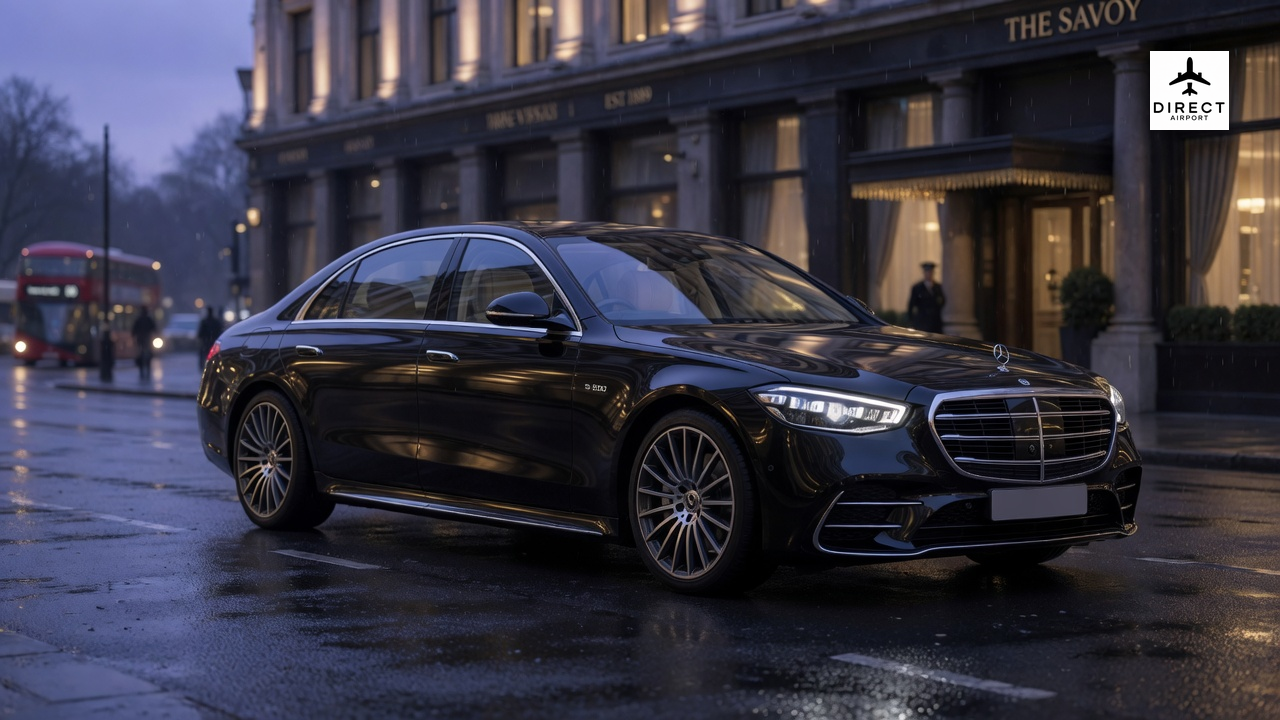
Mercedes S-Class or Audi A8 for clients prioritising maximum comfort and prestige — ideal for senior executives, international visitors, or occasions where first impression matters.
Mercedes Viano or V-Class MPVs for small groups, families, or passengers with extra luggage — these offer seven-seat capacity without compromising on the luxury experience.
The vehicle should be immaculate, professionally maintained, and equipped with amenities like phone chargers, complimentary water, and a quiet cabin suited to business calls. If a company uses generic, worn minicabs for “executive” bookings, they’re cutting corners that will be visible the moment you arrive.
Is an Executive Transfer Worth It Compared to the Heathrow Express or Ride-Hailing Apps?
The answer depends on your priorities, but the maths are worth running.
The Heathrow Express is fast — 15 minutes from terminal to central London. But it delivers you to Paddington Station, not your hotel or office. From there, you’ll need an additional taxi or tube journey, adding 20–40 minutes and cost. It’s excellent for city-centre destinations but inflexible for suburban or off-peak routes. At £28–35 per person, it’s cheap until you factor in the connecting transport.
Ride-hailing apps like Uber offer convenience and low upfront pricing. But they’re also the source of exactly the stress an executive transfer eliminates. During peak hours — which is precisely when you’re trying to catch a flight — surge pricing can double or triple your fare. A £20 journey becomes £50. You’re dependent on driver availability (sometimes scarce at airports), variable professionalism, and the app’s reliability. Cancel within the window and you’re charged. Miss your flight because the driver went off-route, and you have no recourse.
An executive transfer costs more than a suppressed ride-hail price (typically £40–80 depending on airport and destination), but less than Uber’s surge fares and often 20–40% cheaper than peak-hour app pricing. What you’re paying for isn’t just transport; it’s certainty. Your driver will be there. Your price won’t change. You’ll arrive on time and composed. For corporate clients, this certainty has tangible value — a missed flight costs far more than the premium of a fixed-price transfer.
For a single leisure trip, Uber might win on cost. For regular travel, corporate policy, or any journey where reliability is non-negotiable, an executive transfer is worth the investment.
How Far in Advance Should I Book?
Most executive transfer services will accept bookings up to the moment of departure, but planning ahead is wise.
Ideal booking window: 3–7 days before travel. This gives the company time to confirm vehicle allocation, brief your driver, and build in buffer time for any last-minute coordination. It also removes the stress of a last-minute scramble.
Acceptable: 24 hours or less. Reputable operators can handle next-day bookings, but you’re relying on availability. A rush booking is more likely to result in a vehicle allocation issue or a less-experienced driver than a pre-planned journey.
Emergency bookings (same-day or within hours). Most providers accommodate these, but don’t rely on it. If you must book same-day, call the company directly rather than relying on automated systems — you’ll speak to a dispatcher who can prioritise your request.
For recurring corporate accounts or regular travel, many operators offer standing arrangements, eliminating the need to book at all. Your driver and vehicle are pre-assigned; you simply confirm dates as they approach.
What Happens If My Flight Is Delayed?
This is where executive transfer services prove their value.
A reputable provider will monitor your flight in real time using live airline data. If your flight is delayed, your pickup time adjusts automatically — no action required on your part. You’ll receive notification via email or SMS confirming your new collection time.
Free waiting time is typically built in as standard for executive bookings — usually 60 minutes from your expected arrival time. This means if you land late but within the waiting window, there’s no additional charge. The driver waits; you collect your luggage at leisure; the service absorbs the cost of their idle time as part of the premium you’ve paid.
Beyond the waiting window, charges apply — but these are disclosed upfront and calculated fairly (not as punitive “waiting fees”). A professional operator makes this transparent before you book, so there are no surprises.
This automatic adjustment is impossible with a standard minicab or ride-hailing app. You’d have to cancel and rebook, facing potential re-surge pricing or unavailability. With a fixed-price transfer, the delay is their problem to solve, not yours.
Are Executive Transfers Available 24/7?
Yes — and this matters more than you’d think.
London’s airports operate round-the-clock, which means flights depart and land at every hour. A comprehensive executive transfer service must match that availability. Whether you’re catching a 4 a.m. flight or landing at 2 a.m., the service should be operational and ready.
This 24/7 availability extends to weekends and bank holidays — times when ride-hailing availability is thinnest and surge pricing is highest. A late-night landing on a Sunday is precisely when an executive transfer’s guaranteed availability becomes invaluable.
Confirm this explicitly when booking. Some operators offer 24/7 claims but have blackout hours or surcharges for off-peak travel. A transparent provider will confirm availability and pricing for your exact travel time upfront.
How Is Pricing Structured — Is It Fixed or Metered?
Pricing structure is fundamental to choosing an executive transfer provider.
Fixed-price transfers quote a single, all-inclusive fare at booking. This covers the driver, the vehicle, fuel, congestion charge (for central London routes), and motorway tolls. The price doesn’t change based on traffic, route taken, or how long the journey takes. What you’re quoted is what you pay.
Metered fares charge by time and distance, typically starting at a base fare and accumulating per mile or minute of travel. These are cheaper in theory during light traffic but unpredictable during congestion. They’re also prone to route manipulation by drivers seeking longer fares.
Hybrid models offer fixed pricing for standard routes (e.g., Heathrow to central London) but may apply metered rates for unusual destinations or off-airport pickups.
For airport transfers, fixed pricing is overwhelmingly preferable. Your journey is predictable; traffic conditions are largely foreseeable; a fixed quote eliminates the risk of a £60 journey becoming £120 because of the M25.
Avoid any provider that won’t quote you a fixed price before you commit. Metered fares at airports are a red flag for companies that lack the operational efficiency to absorb route variation — or are deliberately ambiguous to extract higher fares.
What Makes a Reputable Executive Transfer Company?
Looking across the London market, several markers separate genuinely professional operators from budget minicab services wearing a “premium” label.
Transparency at every step. From booking to final invoice, a reputable company communicates clearly and answers questions without defensiveness. They publish their licence number, insurance details, and driver vetting standards. If you have to dig for this information, they don’t want you to have it.
Genuine customer feedback. Independent reviews on platforms like Trustpilot or Google Reviews reveal how a company actually operates, especially in moments of difficulty. A company with hundreds of five-star reviews and consistent mention of punctuality and professionalism is far more credible than marketing claims alone.
Fleet quality and age. Premium vehicles properly maintained — with low mileage, recent servicing records, and visible cleanliness — indicate a company that invests in the customer experience. A fleet of vehicles over ten years old, however clean, signals corner-cutting.
Driver training and standards. Reputable operators invest in driver training beyond the legal minimum. They teach customer service, communication with corporate clients, and protocol for handling issues. This training is visible in driver behaviour — politeness, punctuality, local knowledge, professionalism.
Handling of problems. The test of a service isn’t whether everything goes perfectly; it’s what happens when it doesn’t. A reputable operator owns mistakes, compensates fairly, and learns from failures rather than defending them. Check reviews for how the company responds to complaints — defensive silence is a warning sign.
Stability and longevity. A company that’s been operating consistently for years has weathered market fluctuations and customer demands. Newer operators may be innovative but lack the operational maturity to handle problems at scale. Established firms have systems in place.
No last-minute cancellations. A professional operator has sufficient driver capacity that they don’t cancel bookings due to “driver unavailability” hours before travel. If a provider regularly cancels on customers, they’re overcommitting to jobs they can’t reliably fulfil.
Conclusion
Booking an executive airport transfer in London is straightforward once you know what to evaluate. You’re not just purchasing transport; you’re buying certainty, professionalism, and the peace of mind that your journey to the airport will be handled by a service that treats your time as valuable.
Start by confirming the provider covers your departure airport, offers fixed pricing locked at booking, and operates 24/7 if needed. Verify their TfL licence, check independent customer reviews, and confirm they monitor your flight automatically. Ask about their fleet quality and what vehicles you’ll receive.
Then book. Arrive at the terminal composed, on time, and ready — which is precisely the point.
Frequently Asked Questions
What is an executive airport transfer and how does it differ from a regular taxi?
An executive airport transfer is a premium transportation service that provides professional drivers, high-end vehicles, and personalized service for airport journeys. Unlike regular taxis, executive transfers offer fixed pricing, advance booking guarantees, and a more comfortable, reliable experience tailored for business travelers.
How far in advance should I book an executive airport transfer in London?
It is recommended to book your executive airport transfer at least 24-48 hours in advance to ensure vehicle availability and allow time for personalized arrangements. For peak travel periods or special requirements, booking 3-7 days ahead provides additional flexibility and peace of mind.
What is included in an executive airport transfer service?
Executive airport transfer services typically include a professional driver, a premium vehicle, flight tracking, meet-and-greet services, and complimentary amenities such as Wi-Fi or refreshments. Some providers also offer luggage assistance and flexible wait times for arriving passengers.
Are executive airport transfers more expensive than regular airport taxis in London?
Executive airport transfers generally cost more than standard taxis, but they offer better value through fixed pricing, professional service, and reliability. The premium price ensures no surge pricing, guaranteed vehicle availability, and a business-appropriate experience.
What payment methods are accepted for booking executive airport transfers?
Most executive airport transfer providers accept multiple payment methods including credit cards, debit cards, online banking transfers, and corporate accounts. Many platforms also allow payment at booking or upon arrival, providing flexibility for business travelers with expense management requirements.